September is my Favourite Month. It Also Scares the Crap Outta Me.
Chalk this one up as “journal entry” because I’m too anxious to tie it to a business lesson today.
Content Warning: Medical trauma, near-death experiences, and subtle mentions of fertility issues.

September is my favourite month. It’s still technically summer, but the first hints of fall are starting to show. The landscape around me changes from green every where to pops of yellows, oranges, and reds. The air loses the stifling weight of summer’s humidity and turns crisp and fresh. The temperature drops below 25 degrees most days, and I can go outside without worrying about whether I’m going develop heat exhaustion. I can also stop consuming massive quantities of water and electrolytes to prevent said heat exhaustion.
There’s also a return to routine after what’s usually a different kind of busyness - the kind that involves lots of socialization.
Now, I usually get about 2 weeks of Glorious September, before the anxiety starts creeping in.
Because I’m a person who collects complex medical issues like it’s a trading card game, and historically, September is the month when my body forgets how to function in a way that keeps me alive.
It’s one of these weird, unexplainable consistencies about living with chronic illness - there’s always a pattern, even if you don’t know what or why it is. And my pattern is that my body fails in September. I just don’t know why, and nobody else knows either.
It’s happened so frequently now that I walk into September mostly convinced that I will have to spend to at least one or two nights in the hospital. It’s also why I keep a hospital go-bag in my car. It contains multiple changes of clothes, a book, a notebook, a spare phone charger, and essential personal care items. You know, the kind of bag that expectant mothers usually have ready to go when approaching their due date.
People with chronic illness also have one for the same reason - so that we’re prepared in case we don’t have time to pack before heading to the hospital.
Gotta Catch 'em All
I collected my first chronic illness diagnosis at 24 when I was diagnosed with what is now called Polyendocrine Metabolic Ovarian Syndrome, but what I knew then as PCOS.
Polyendocrine metabolic ovarian syndrome (PMOS) is a set of symptoms caused by a problem with a woman’s hormones. It affects the ovaries. But it can also affect the rest of the body. PMOS is a very common condition in women of childbearing age. In some cases, it can lead to serious health issues if not treated. — Johns Hopkins Medicine
I was handed a diagnosis and told to lose weight and wax if the facial hair bothered me. But beyond that? Nothing. No guidance, no recommendations, no information. Just a vague hand-waving that it shouldn’t impact anything dramatically.
And it didn’t really, until it came time to have my second child, then it impacted EVERYTHING. But that story isn’t for here and now, aside from the fact that my journey to have my son resulted in me collecting my second chronic illness diagnosis: Antiphospholipid Antibody Syndrome. Diagnosed by my fertility doctor, treated in terms of fertility, and then promptly ignored once I was 6 weeks postpartum.
Individuals who experience complications from antiphospholipid antibodies are diagnosed with Antiphospholipid Antibody Syndrome (APS). This condition can occur both in people with lupus and those without lupus. Fifty percent of people with lupus have APS. The presence of one or more clinical episodes of thromboses (blood clots) and/or complications during pregnancy, such as miscarriage or premature birth, in conjunction with a significant level of anticardiolipin antibodies, antiphospholipid antibodies, and/or anti-ß2 GPI anti- antibodies usually indicates the presence of APS. Some people with primary APS later develop lupus, suggesting a connection between the two conditions. — Johns Hopkins Lupus Center
Fast forward 6 years and I collected my third chronic illness diagnosis after a 4-year fight to get someone to take my chronic pain and exhaustion (brought on by a car accident) seriously: Central Sensitization Syndrome (CSS).
Central sensitization syndrome (CSS) is a condition where the central nervous system—the brain and spinal cord—amplifies nerve signals, turning up the volume on pain and other sensory inputs. — Cleveland Clinic Journal of Medicine
The chronic pain and exhaustion was the primary motivation for me to start my first business in 2010 after burning out trying to be a single parent and a full-time employee.
For the most part, I learned to manage throughout - because really, what was the alternative? To shrivel up and die? I don’t think so.
So I learned to wax my face. I got used to the occasional ovarian cyst. I learned how to manage the constant elevated pain using nutrition, energy balance, and supplements. I got used to not bleeding - either menstrually, or when I cut myself.
I grew my small business into an agency. I bought a house. I took my kids on fancy vacations. All while being a single person managing chronic illness.
September 2017.
And then everything changed.
In September 2017, I woke up and my right arm was tingly and a bit sore. I thought maybe I’d pulled a muscle or pinched a nerve, and because I was so used to being in pain daily, I ignore it and went about my day.
That evening, while visiting with a friend, she commented that my arm was looking a little gray.
Not pale, GRAY.
She encouraged me to go to the hospital. I agreed. Then went home, ate something, packed a bag, and made my way to the ER.
In hindsight, I should have been alarmed when the nurse handed me a call bell after checking me in, telling me to press it if anything changed in how I felt. But again, chronic pain, frequent hospital visits. This was no different. Until the doctor came and told me that there was zero circulation in my arm and I needed surgery NOW to save it.
Until the doctor came and told me that there was zero circulation in my arm and I needed surgery NOW to save it.
10 years after being diagnosed with APS, it was rearing it’s ugly head in a non-fertility way. I’d developed an arterial blood clot. And for some reason, no one knew why. And nobody warned me this was a possibility.
September 2018
I’ll spare you the long recovery and investigation period; it’s largely boring. Except for one key detail. I saw a “specialist” in July of 2018, who stated emphatically that I did not, in fact have APS, and that the clot was likely a one-off; I could stop taking my blood thinners.
So I did.
And 2 months later, in September 2018 I had an ischemic brainstem infarction - a stroke.
I was 40.


Yay! My fourth chronic illness diagnosis! I almost have a complete set!
That specialist was wrong. Emphatically wrong.
Because of him, I spent over a year in rehabilitation, learning to talk, walk, and think again. And I’ve not missed a day of my blood thinners since.
Recovering & Rebuilding - Until September 2021
At this point, I can almost hear you saying “But wait - how do the other chronic conditions come in to this?”
And truthfully, I’d been managing them for so long that they were pretty much an afterthought for me as well. I was working daily to recover from my stroke, learning how to manage being on blood thinners. Rebuilding my business - because that absolutely died when I had my stroke. Rebuilding my life.
I’d get the occasional ovarian cyst, but it didn’t really impact my life in big ways until September 2021, when they usual pain I’d experience every couple of cycles didn’t go away like usual.
Instead, it increased.
But chronic pain sufferers have an unrealistic understanding how much pain is too much and when it should be dealt with in the hospital.
So I waited it out. And waited it out some more. Until I couldn’t bare it anymore.
Which, for the record, was 2 weeks.
Little did I know that during those 2 weeks, the cyst ruptured instead of just decreasing on its own, and I was bleeding internally.
Because blood thinners. (Yeah, I know. I’m smart, but apparently that one didn’t dawn on me until after the fact.)
By the time I was in the ER, I had lost enough blood to be milliliters from death. I received a combined 8 units of red blood cells, plasma, and platelets - or roughly 2 liters of blood products to replace what I’d lost. And a LOT of lectures from EVERYONE - doctors, nurses, care aids, radiology, loved ones, the dog - about being aware of how much pain is too much and when to come into the hospital.

September 2025: Round Two!
But September couldn’t have me yet! I had the offending ovary removed entirely, and went on to recover quite well.
And when my remaining ovary decided to perform the same “let’s kill Trina” act in September 2025, I was ON it.
Within 3 hours of identifying what was going on, I was in the ER waiting for another emergency partial oophorectomy.
Still needed 5 units of blood products though.
Blood thinners are going to what they’re supposed to, after all.
(Do I still have Polyendocrine Metabolic Ovarian Syndrome if I don’t have ovaries? So far, no one has been able to answer this. I suspect we might need another name change on this one.)
September 2026: Counting Down the Days
So here we are, in September 2026. I have 4 “Near-Death September” experiences in my history, and I’m wondering if I’ll make it through to October without a hospital visit.
Only 22 more days to go!
My anxiety is increasing daily, because I truly do not know if this is the September that takes me out.
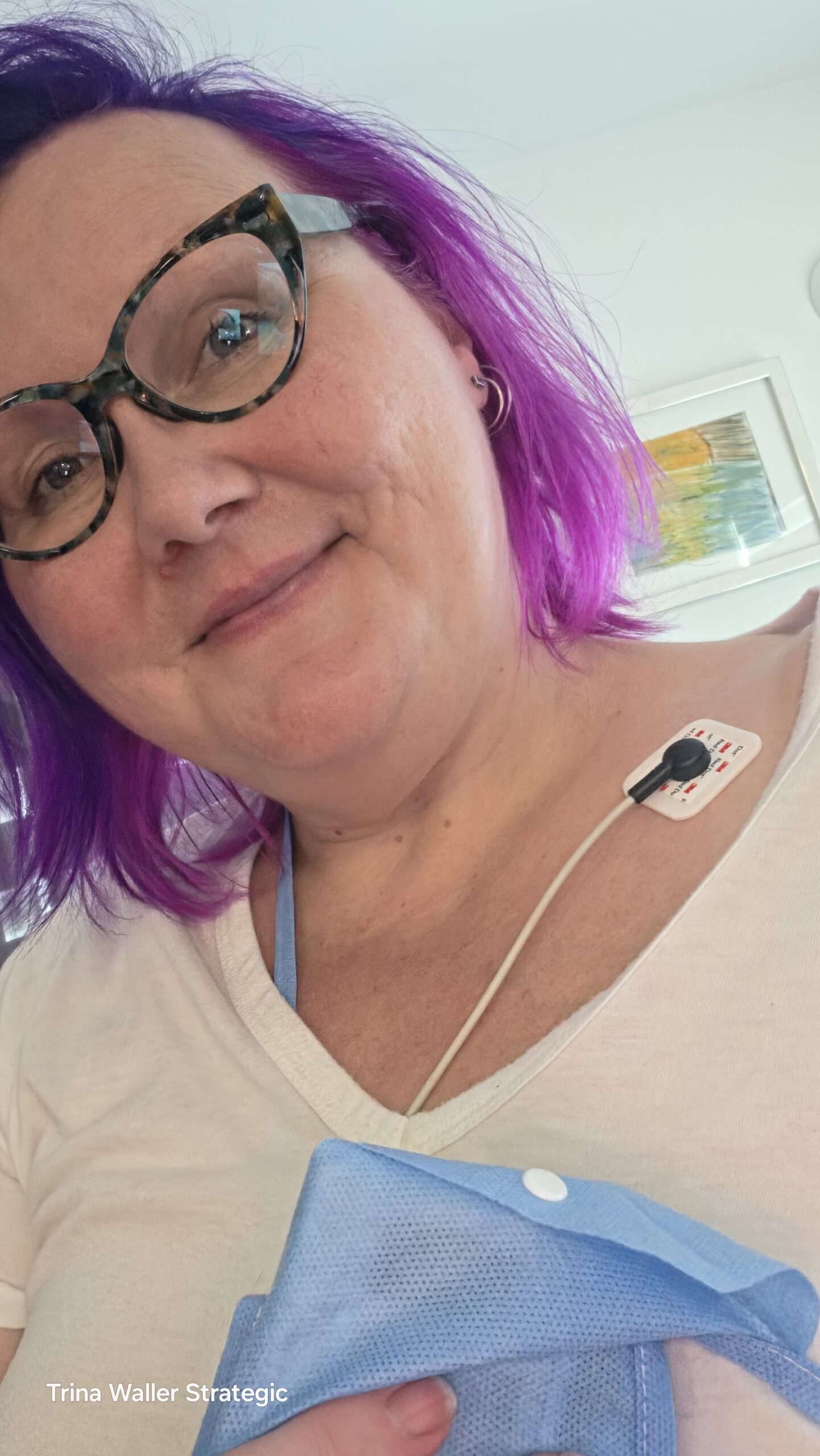
But today, I had my heart checked and came home with a Holter monitor.
You know, just to be sure.
And for the record, I am very grateful to be alive. I am very appreciative that even though it occasionally gets it wrong, this body has managed to keep me alive. And I’m going to keep living hard as long as I can. Because I know all too well how fast it can change.
But until October 1st, I’m going to be both grateful and a little anxious.